Locked Out of Your Own Success: How Token Vesting Schedules Create the Illusion of Liquidity for Web3 Founders
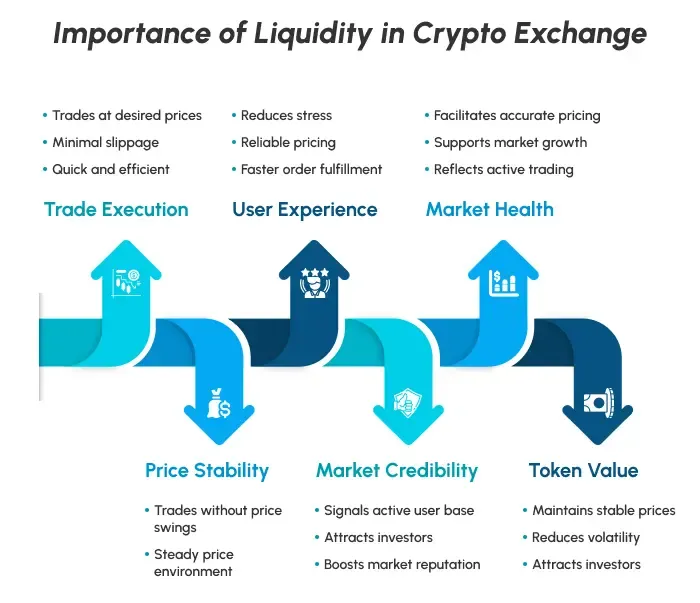
Photo: cryptocurrency token exchange trading liquidity blockchain market, via www.pixelwebsolutions.com
The press release writes itself. A Web3 startup lands a listing on a Tier-1 exchange, the token price pops on debut day, and the founding team poses for a metaphorical photograph in front of a nine-figure market cap. What the press release does not mention is that perhaps three percent of that market cap can actually change hands without collapsing the price entirely. The rest is locked, vested, concentrated, or otherwise inaccessible—a condition practitioners have begun calling phantom liquidity.
For founders operating in the US market, where institutional scrutiny is intensifying and retail investors are growing more sophisticated, the gap between headline valuation and genuine tradeable depth is no longer a footnote. It is increasingly a liability.
What Phantom Liquidity Actually Looks Like
Phantom liquidity is not a single phenomenon. It is the aggregate effect of several overlapping structural choices that founders make—often under pressure, often without fully modeling the downstream consequences.
Consider a hypothetical protocol that raises a seed round and a Series A through Simple Agreements for Future Tokens, allocates thirty percent of total supply to the founding team, reserves twenty percent for a treasury DAO, and distributes fifteen percent to early investors. By the time the token lists publicly, the freely floating supply available to ordinary market participants might represent less than ten percent of the total token count. The exchange's order book looks thin, bid-ask spreads widen under any meaningful selling pressure, and the project's market cap—calculated against the full circulating supply—overstates economic reality by an order of magnitude.
This is not hypothetical. It is the operating condition of a significant portion of projects that have listed on major exchanges over the past three years.
The Vesting Schedule as a Double-Edged Instrument
Vesting schedules exist for legitimate reasons. They align long-term incentives, discourage mercenary capital, and signal to the market that founders and early backers believe in the project's multi-year trajectory. A well-designed vesting structure is genuinely protective.
The problem arises when vesting timelines are constructed in isolation from liquidity modeling. A standard four-year linear vest with a one-year cliff—borrowed almost verbatim from Silicon Valley equity compensation norms—does not translate cleanly into token economics. Equity in a private company has no public price to defend. A token does.
When a cliff date arrives and a substantial allocation unlocks simultaneously, the market reads that event as a potential sell signal regardless of founder intent. Even if no one sells, the anticipation of selling can suppress price and volume in the weeks preceding the unlock. Founders who have not proactively communicated their post-cliff intentions—or who have not engineered smoother release mechanisms—often find themselves managing a price crisis rather than celebrating a milestone.
Investor Lock-Ups and the Coordination Problem
Founder tokens are only part of the equation. Early-stage investors, particularly those who participated in pre-seed or seed rounds at steep discounts to the listing price, face enormous economic incentive to exit as soon as their lock-up periods expire. This is not a character flaw; it is rational portfolio management.
The coordination problem emerges when multiple investor cohorts hold overlapping lock-up schedules and no single party has both the authority and the incentive to manage the aggregate release in a market-sensitive way. A DAO treasury cannot compel a venture fund to delay its exit. A founding team cannot unilaterally extend investor lock-ups after the fact without risking legal and reputational consequences.
Founders who wait until after listing to address this coordination gap are already behind. The time to establish voluntary extended lock-up agreements, staggered release schedules, and public unlock calendars is during the capital formation stage, when investors are still motivated to accommodate founder preferences in exchange for allocation access.
Measuring the Real Float Before You List
A practical starting point for any founder approaching a token generation event is to construct what might be called a liquidity-adjusted float model. This is distinct from the standard circulating supply calculation that exchanges and data aggregators publish.
The liquidity-adjusted float accounts for: tokens subject to vesting or lock-up agreements; founder and team allocations that are technically unlocked but practically unsellable due to reputational constraints; treasury reserves that require multi-sig or DAO governance approval to deploy; and tokens held by investors with demonstrated historical patterns of long-term holding.
What remains after these exclusions is a reasonable approximation of the supply that will actually participate in price discovery on any given trading day. If that number is uncomfortably small relative to the project's target market cap, the founder has time to intervene—by adjusting allocation percentages, restructuring vesting timelines, or calibrating the initial listing price to a more defensible capitalization figure.
Designing for Genuine Market Utility
Liquidity is not purely a financial engineering problem. It is also a product design question. Protocols that create genuine on-chain demand for their tokens—through staking mechanisms, governance participation requirements, fee-sharing arrangements, or ecosystem incentive programs—generate organic buying pressure that offsets the sell-side overhang from unlocking schedules.
This distinction matters enormously for US-based projects navigating the current regulatory environment. A token that functions primarily as a speculative instrument dependent on thin float to maintain its price is a fragile construct. A token embedded in a functioning economic system, where participants acquire and hold it for reasons beyond price appreciation, is structurally more resilient to unlock events.
Founders should be asking, during the protocol design phase rather than the post-launch crisis phase, what proportion of token demand is utility-driven versus speculation-driven. The answer shapes everything from vesting design to exchange strategy to investor communications.
Communicating Unlock Events Proactively
Transparency is underutilized as a liquidity management tool. Projects that publish detailed, publicly accessible unlock calendars—updated in real time and integrated into investor relations communications—tend to experience less severe price volatility around cliff dates than projects that allow unlock events to arrive without context.
The logic is straightforward. Markets price in uncertainty. When an unlock date is known, communicated, and accompanied by founder commentary on anticipated behavior, the market has already begun to process the event before it occurs. When an unlock arrives without context, the market fills the information vacuum with worst-case assumptions.
For founders building in the Web3 space, where community trust is a foundational asset, proactive unlock communication also reinforces the credibility signals that sophisticated investors and protocol users increasingly require before committing meaningful capital or participation.
The Milestone That Actually Matters
A token listing is a beginning, not a conclusion. The founders who treat exchange access as a fundraising finish line rather than a liquidity architecture starting point are the ones who find themselves managing phantom markets six months later—watching a market cap that looks impressive on a dashboard but cannot support any meaningful economic activity without unraveling.
The genuine milestone is not the listing. It is the moment when a project's token has sufficient real float, sufficient utility-driven demand, and sufficient market depth to function as the economic infrastructure its protocol requires. Building toward that milestone—deliberately, structurally, and with eyes open to the vesting and lock-up dynamics that stand between the listing and genuine liquidity—is among the most consequential work a Web3 founder can undertake.